Learning Hub
The intranet 42 Heilbronn runs on — the campus systems we need, in one place.
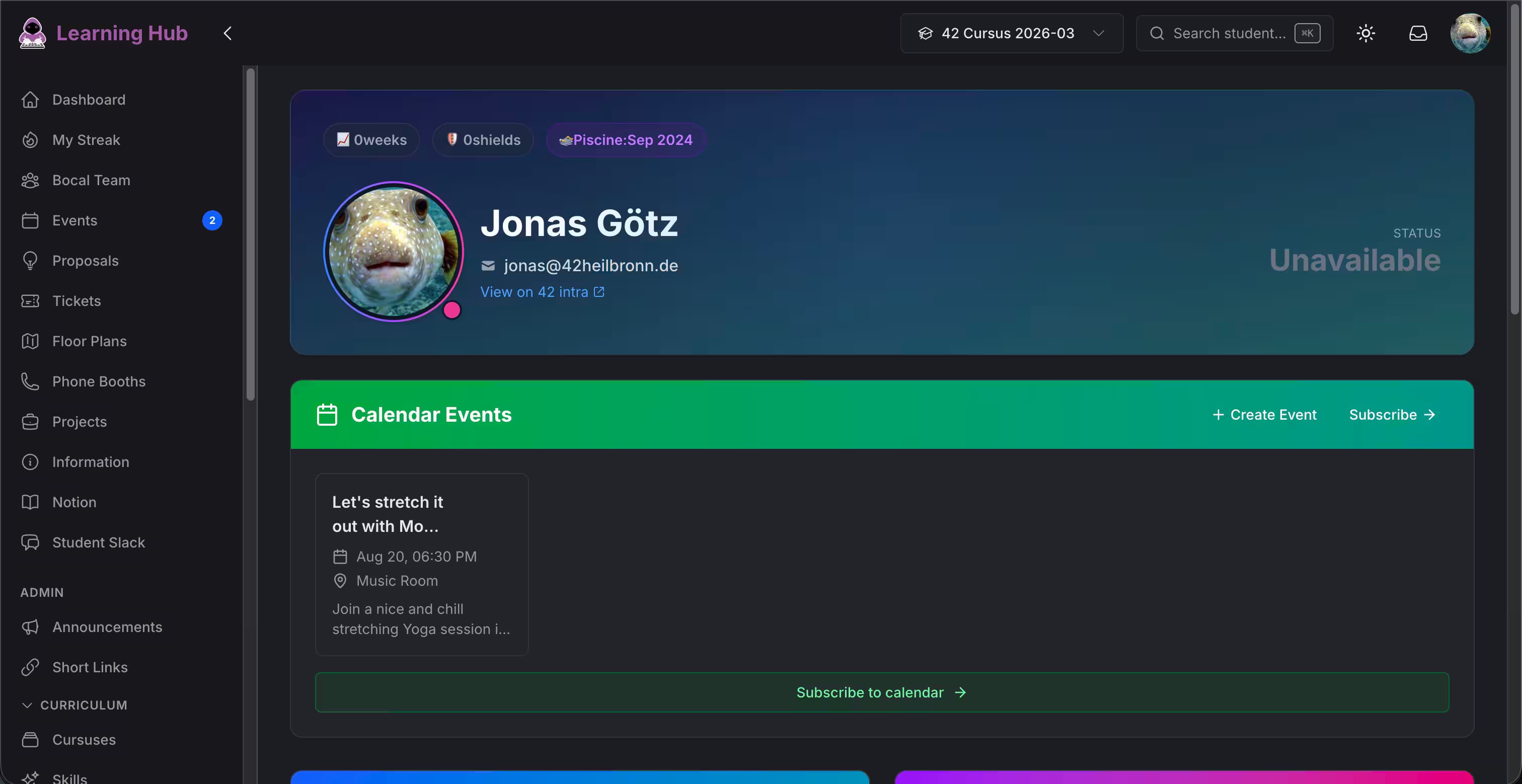
At 42 there is nobody standing at the front of a room. Students unlock projects by finishing the ones before them, review each other's work, and organise themselves. That model only holds if the software underneath it holds, because the software is doing what a timetable and a teacher would do elsewhere.
The Learning Hub is that software. It is the intranet the campus signs into: the dashboard a student sees, the events they book, the projects they are working through, and the administration the staff side needs behind it.
What is in it
It grew out of the day-to-day of running the campus, which is why the feature list reads like a list of things that used to be done by hand:
- Dashboard — where a student stands: streak, shields, their Piscine cohort, and whether they are available, all above the day's calendar.
- Events — what is on and who is coming, with a Subscribe to calendar button, because an event nobody sees is an event nobody attends.
- Projects, cursuses and skills — the curriculum, and progress through it, switched per cursus from the header.
- Tickets and proposals — how a student asks for something or suggests it, rather than finding whoever happens to be at the desk.
- Floor plans and phone booths — where things and people are, which on a campus of a few hundred is a genuine question.
- Announcements and short links — the staff side of talking to everyone.
- Notion and Student Slack — the tools that live elsewhere, reachable from the same sidebar rather than from a bookmark folder.
There is a student search on ⌘K from anywhere, which is the feature the staff
side uses most and the one that would be missed first.
Student and project data is imported from 42's own API on a schedule, so the Hub stays in step with the wider network rather than becoming a second source of truth that slowly disagrees with the first.
Signing in
Getting authentication right mattered more here than anywhere else: everyone on campus uses this, several times a day, on shared machines.
| Method | Role |
|---|---|
| Email magic link | The primary route — no password to forget |
| WebAuthn passkeys | Passwordless, for the people who want it |
| TOTP | Optional second factor |
| Password + TOTP | Custom admin accounts only |
A JWT lives in a cookie, and Next.js middleware verifies it on every request and refreshes it silently when it expires — so a session ending mid-task is not a thing that happens. The Hub also exposes OAuth endpoints of its own, which is what lets other campus tools authenticate people against it instead of each one growing its own login.
How it is built
A monorepo, with the split along the line where the work actually divides:
frontend/    Next.js 15, App Router, Server Components
  lib/services/     API client layer
  lib/actions/      Server Actions
  lib/validations/  Zod schemas

backend/     Python 3.13, FastAPI, async throughout
  app/routes/       auth, events, projects, oauth, calendar, streaks
  app/models/       SQLModel — SQLAlchemy and Pydantic in one
  app/services/     S3, email, compensation, skills
  app/crons/        import from the 42 API, calendar sync
The frontend proxies to the backend through Next rewrites, so the browser only ever talks to one origin. React Query holds server state, TanStack Form and Table handle the parts of an admin interface that are genuinely hard, and the UI is shadcn/ui on Radix with Tailwind 4.
Around those two sit the services that make the features possible rather than merely nice: PostgreSQL 16 with a pooled connection, Valkey for caching, and a Radicale CalDAV server, so a student subscribes once and campus events appear in the calendar app they already use.
Self-hosted, on purpose
All of it runs on infrastructure I look after. That is the reason the calendar integration and the OAuth provider exist at all — both are the kind of thing that is straightforward when you own the boxes and a procurement exercise when you do not.
Local development is a devbox shell and devbox services up: Postgres, Valkey,
nginx, a mail catcher and Radicale, all running the way they run in production.
Onboarding someone should not begin with a day of installing databases.